If you want to save money at the grocery store without spending your whole Saturday clipping paper coupons, you are in the right place. I’m a budget-obsessed mom, and this summer I finally cracked the code on keeping my food bill low without eating boring meals. It comes down to three easy habits: apps, coupons, and smart swaps. Let me walk you through exactly what works.
- Why Groceries Feel So Expensive This Summer
- Download a Coupon App Before You Shop
- Master Couponing Without the Overwhelm
- Smart Substitutes That Cut Your Cart in Half
- Budget Summer Chickpea Pasta Salad Recipe
Why Groceries Feel So Expensive This Summer
Summer should be the season of cheap produce and backyard cookouts, but somehow my cart kept getting pricier. Part of the problem is shrinkflation, where brands quietly shrink the package but keep the price the same. That bag of chips that used to be 12 ounces? Now it’s 9.5, and you didn’t even notice.
Once I understood shrinkflation, I started checking the unit price on the shelf tag instead of the sticker price out front. If you want the full breakdown of how this sneaky trend works, this {{SOURCE_LINK:1:guide to shrinkflation}} explains it clearly. Knowing what’s happening helps you fight back.
The good news is you have more control than you think. A few small changes each trip add up to real cash, and that’s the whole reason I learned how to save money at the grocery store in the first place.
Download a Coupon App Before You Shop
Before you set foot in the store, download a free coupon app. My favorites are Ibotta, Fetch, and your store’s own app. All three are free, so you’re spending nothing to start saving, which fits perfectly into any under-$25 grocery mindset.
Here’s my routine: I scan my receipt into Ibotta and Fetch after every trip. Fetch gives you points on almost any grocery receipt, no clipping required. Ibotta pays cashback on specific items you activate before shopping. Stacking both means one receipt earns twice.
Your store loyalty app is the third piece. Load digital coupons before you go and they apply automatically at checkout. I usually clear $8 to $15 per trip this way. If you’re serious about learning to save money at the grocery store, the coupon app step is non-negotiable.
Master Couponing Without the Overwhelm
Couponing scares people because they picture giant binders and hours of sorting. I don’t do that. I spend maybe ten minutes on Sunday matching digital coupons to my store’s weekly sale flyer, and that’s it.
The magic is in the match: pair a digital coupon with an item that’s already on sale, and the savings double. Buy those sale items in bulk if they’re shelf-stable or freezable. This is called stockpiling, and it’s the single fastest way to save money at the grocery store over time.
Keep a simple price book too. Jot down the lowest price you’ve seen for staples like pasta, rice, and canned beans. When you see that rock-bottom price again, you buy extra. If you’re just getting started, my beginner pantry stocking guide pairs perfectly with this couponing habit.
Don’t chase every deal. If a coupon pushes you to buy something your family won’t eat, it isn’t a saving, it’s a waste. Only clip what you’d actually use.
Smart Substitutes That Cut Your Cart in Half
Substitutes are my secret weapon, especially in summer when produce is cheap and plentiful. Swapping pricey items for cheaper equals is one of the easiest ways to save money at the grocery store without anyone at the dinner table noticing a difference.
Trade boneless chicken breast for bone-in thighs and you’ll cut the protein cost nearly in half while getting more flavor. Swap fresh berries for frozen in smoothies and baking, since frozen is picked ripe and costs less. Replace name-brand canned beans with the store brand, which is usually the same beans for a dollar less.
For summer meals, dried beans and canned chickpeas replace expensive meat entirely a few nights a week. A can of chickpeas costs under a dollar and stretches into salads, pasta, and dips. Plain Greek yogurt subs beautifully for sour cream and mayo, and it’s often cheaper by the ounce, especially when you dodge shrinkflation on the smaller tubs.
Buy whole heads of lettuce instead of pre-washed bagged salad and you’ll pay a fraction of the price for double the food. These little swaps are how I consistently save money at the grocery store every single week.
Budget Summer Chickpea Pasta Salad Recipe
Here’s the meal that ties every one of these tips together. This chickpea pasta salad uses store-brand pasta, canned chickpeas, and frozen or in-season veggies, so it’s cheap, filling, and perfect for hot summer nights when you don’t want to cook.
It feeds a crowd for a few dollars and keeps in the fridge for days, which means less food waste and more savings. I use whatever veggies are on sale that week, so the recipe flexes with your coupons. This is exactly the kind of dinner that helps you save money at the grocery store while still feeding your family something bright and satisfying.
Make a big batch on Sunday and you’ve got lunches sorted too. Scroll down to the recipe card for the full measurements and steps.
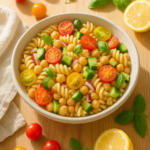
Budget Summer Chickpea Pasta Salad
Ingredients
- 12 oz store-brand rotini or penne pasta
- 1 can (15 oz) chickpeas drained and rinsed
- 1 cup cherry tomatoes halved
- 1 medium cucumber diced
- 1/2 cup red onion finely diced
- 1/2 cup plain Greek yogurt
- 3 tbsp olive oil
- 2 tbsp lemon juice about 1 lemon
- 1 tsp dried oregano
- 1/2 cup fresh basil chopped, optional
- 1/2 tsp salt or to taste
- 1/4 tsp black pepper
Instructions
- Bring a large pot of salted water to a boil and cook the pasta according to package directions until al dente, about 10 to 12 minutes.
- Drain the pasta in a colander and rinse under cold water until fully cooled, then let it drain completely.
- In a large bowl, whisk together the Greek yogurt, olive oil, lemon juice, dried oregano, salt, and black pepper until smooth.
- Add the drained chickpeas, halved cherry tomatoes, diced cucumber, and red onion to the bowl with the dressing.
- Add the cooled pasta and toss everything together until evenly coated in the dressing.
- Stir in the chopped fresh basil, taste, and adjust salt and lemon as needed. Serve immediately or chill for 30 minutes before serving.